

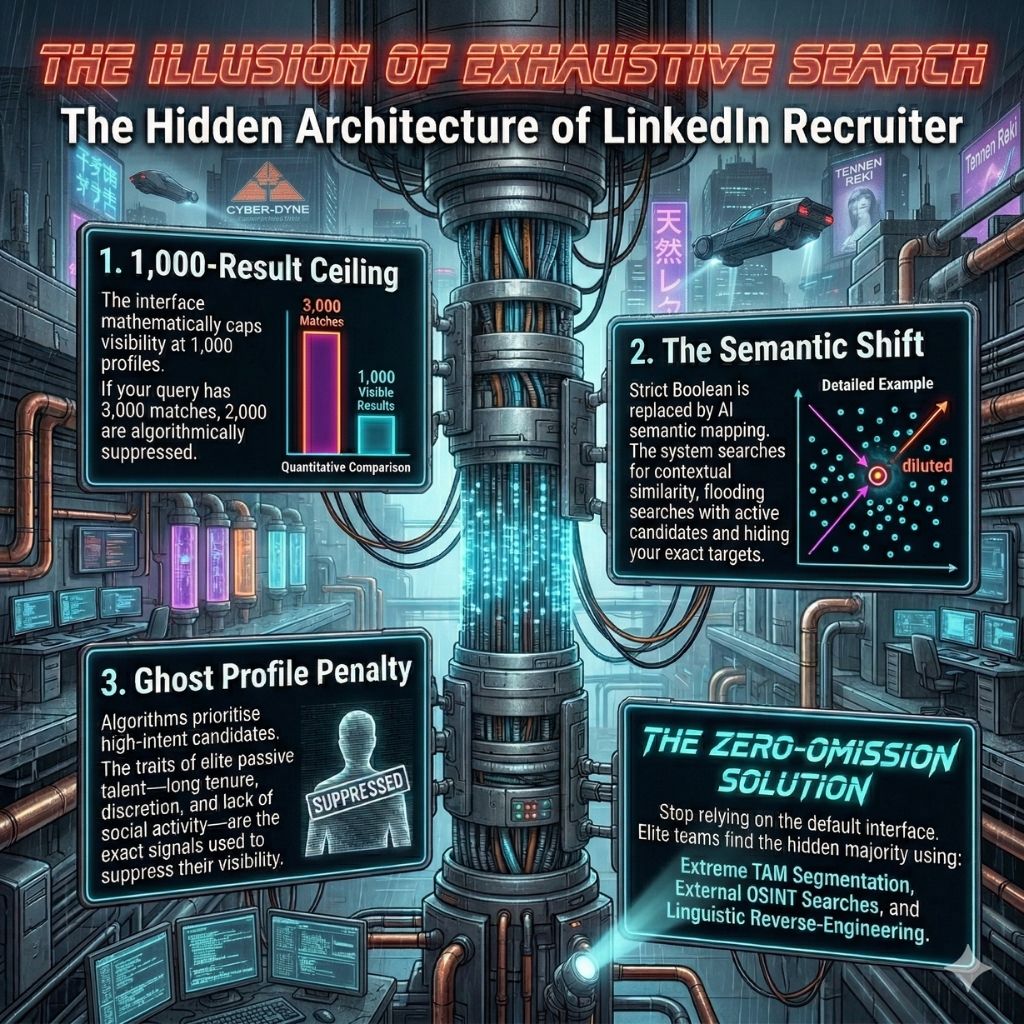
In modern talent acquisition, LinkedIn Recruiter is widely viewed as the definitive, deterministic database of global professional capital. With over one billion profiles, the assumption is simple: if you build the perfect Boolean string, the platform will show you every qualified candidate.
However, a deep dive into the platform’s underlying architecture reveals a different reality. LinkedIn Recruiter is no longer a static repository of resumes. It has evolved into a highly complex, probabilistic recommendation engine designed to optimise user engagement.
For executive search firms and specialist recruiters tasked with executing exhaustive market mapping with zero-omission, understanding this hidden architecture is the only way to uncover the true Total Addressable Market (TAM).
Here are the three structural mechanics changing how elite talent is sourced today:
1. The 1,000-Result Ceiling
Perhaps the most significant architectural barrier to an exhaustive search is the graphical hard cap. Whether your search yields 3,000 or 50,000 matching profiles, the platform’s interface will exclusively populate a maximum of 1,000 results (40 pages).
From an engineering perspective, this optimises server compute costs and prevents mass data scraping. But from a sourcing perspective, if a query yields 3,000 matches, viewing only the top 1,000 means you are missing two-thirds of the qualified pool. The algorithm, not the recruiter, unilaterally decides who makes the cut.
2. The Semantic Shift and the False Positive Paradox
Historically, expert sourcers relied on strict, deterministic Boolean logic. Today, the platform utilises advanced AI language models to generate semantic vector embeddings. It tries to understand the intent of a search rather than just matching exact text strings.
While this helps some recruiters by broadly expanding searches, it introduces severe clunkiness for specialists. A classic example is the keyword “Development.” An algorithm optimising for engagement might flood the top results with highly active Business Development professionals, pushing the highly qualified Software Development Engineers past page 40 into invisibility.
3. The “Ghost Profile” Penalty
The platform’s Generative Recommender engine actively favours candidates who demonstrate a high likelihood to respond. This is measured by recent logins, frequent profile updates and the open-to-work signal.
The paradox here is that the very characteristics defining highly desirable, passive elite talent are the exact variables the algorithm uses to suppress their visibility. These traits include long tenure, loyalty to their current employer and a reluctance to overshare on social media. Furthermore, elite executives frequently strip formal titles from their profiles, rendering them completely invisible to standard filters.
How to Engineer a Zero-Omission Search
Relying passively on default filters guarantees an incomplete view of the market. To navigate this, elite firms are adopting adversarial sourcing methodologies:
- TAM Segmentation: Systematically breaking massive searches down by micro-geographies or granular industries until every query yields fewer than 1,000 results. This ensures zero data loss.
- Open Source Intelligence (OSINT) & X-Ray Searching: Utilising external search engines like Google to bypass internal engagement algorithms and semantic drift. This forces deterministic Boolean matches from the outside in.
- Linguistic Reverse-Engineering: Abandoning structured fields to search unstructured data for behavioural indicators like “Stealth startup” or “Confidential.”
The evolution of recruitment platforms means the era of the simple keyword search is over. Competitive advantage now belongs to the teams who understand the intelligence layer operating beneath the interface.